In a nutshell
- 🔥 Oven hot spots are the hidden cause of domed, sunken, or dry-edged cakes; dry rice both detects uneven heat and helps tame it.
- 🍚 Create a rice map: preheat to 190°C, bake a single layer of rice on a foil-lined tray for 18–22 minutes, then read browning patterns to locate hot/cool zones.
- 🛡️ Use a 1 cm rice bed under your cake tin to buffer bottom heat, reduce ramp rate by design, and add 5–10 minutes for even rise and crumb.
- 🧁 Targeted fixes: bank rice around square-tin corners, fill empty cupcake wells with rice, and use a foil-and-rice radiant shield over known hot strips; rotate once at midpoint.
- 🧰 Pro practice and limits: verify temps with an oven thermometer, preheat 20 minutes, pick light tins and good airflow, keep the cavity clean, and call an engineer if your rice map shows extreme contrast.
Home bakers often blame recipes when a cake rises lopsided, domes too much, or bakes with a dry ring and a gooey centre. The real culprit is frequently your oven’s hot spots—those patches that run hotter than the set temperature, scorching edges while undercooking the middle. Here’s the refreshingly low-tech fix: rice. With a handful of dry grains and a baking tray, you can both reveal and tame uneven heat. In under half an hour, rice shows you exactly where your oven misbehaves, then helps you neutralise it on your next bake. It’s cheap, clean, reusable as a baking weight, and it works with gas, electric, and fan-assisted models.
The Science of Hot Spots and Why Rice Works
Even well-made ovens develop quirks. A slightly miscalibrated thermostat, a failing fan, a glowing bottom element, or a warped rack can drive temperature gradients across the cavity. Convection patterns push heat to corners; door glass sheds heat and cools one side; a dark sheet pan radiates more to the tin right above it. Small disparities—just 10–15°C—can mean dry edges, a cracked crust, or a depressed centre. That’s why one shelf produces elegant layers while another turns out sunken sponges.
Dry rice solves two problems at once. First, it’s a superb heat “detector”. Each grain is a tiny sensor: low moisture, high surface area, and pale starch that browns predictably as temperatures climb. Spread in a single layer, rice registers local conditions quickly, so you see which patches run hot. Second, rice doubles as a thermal buffer during subsequent bakes. Packed under or around a cake tin, it moderates spike-prone radiant heat from elements and hot metal, smoothing the ride so the batter sets evenly instead of racing at the edges. Think of it as a dry, mess-free heat bath.
How to Use Rice to Map Your Oven
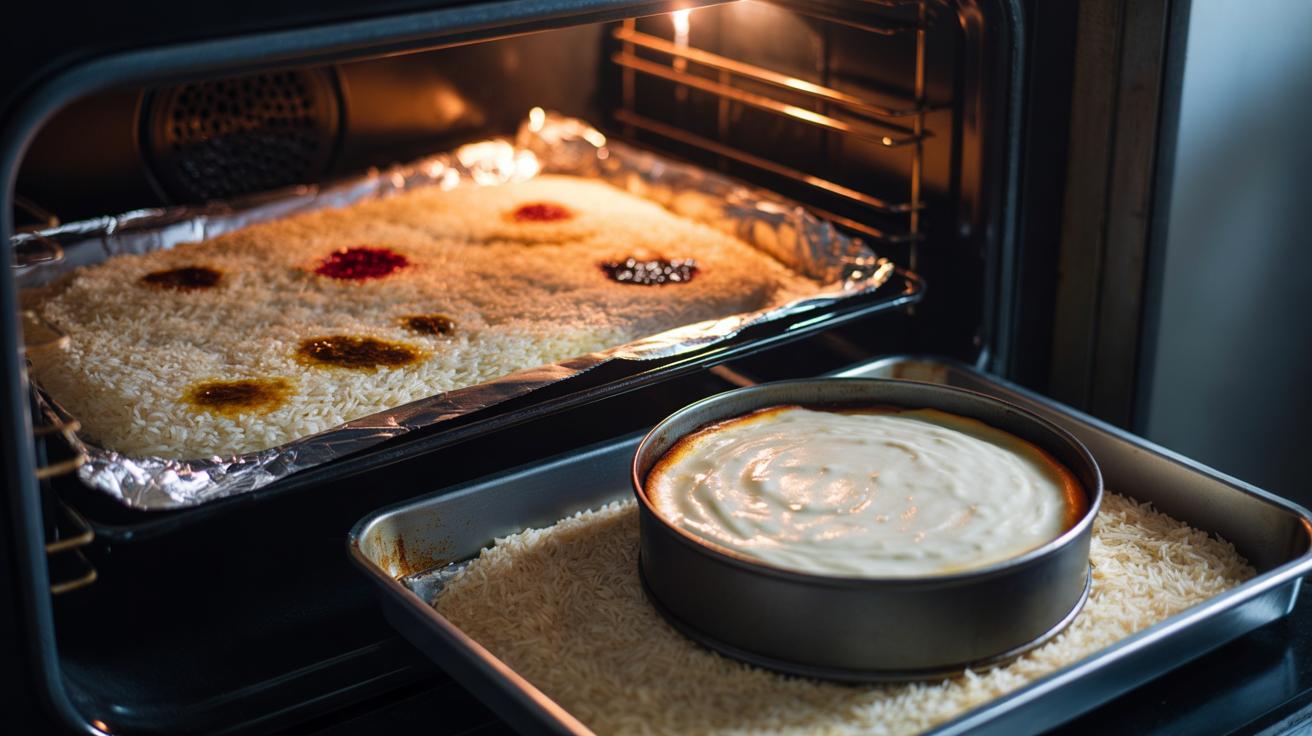
Preheat the oven to 190°C (375°F). Line a light-coloured, rimmed tray with foil. Tip in a single, even layer of uncooked white rice (about 250 g for a standard half-sheet). Slide it onto the middle rack and bake for 18–22 minutes. Do not open the door early. When the timer pings, remove the tray and observe. Where grains are darkest, your oven is hottest; pale patches are cool zones. Photograph the pattern for reference and label the image by rack position—this becomes your permanent rice map. Don’t eat the test rice; save it in a jar labelled “baking weights”.
Use what you learn immediately. Position delicate layers away from the scorch zones. Rotate tins only once, at the mid-point, aligning the cake’s cooler side with your oven’s hotter patch. If a corner runs fierce, shield it with a foil tab or move the tin 2–3 cm off that axis. The simple table below captures the key cues.
| Step | Setting | What You’ll See | Action |
|---|---|---|---|
| Rice layer | 190°C, 18–22 min | Brown clusters = hot spots | Avoid placing cake directly above |
| Rack choice | Middle preferred | Pale = cool zones | Use for delicate centres |
| Rotation | Halfway only | Evening of browning | Align cool side to hot patch |
Fixing the Problem: Rice as a Heat Buffer for Even Cakes
Once you’ve mapped the heat, use rice to calm it. Pour a 1 cm layer of uncooked rice into a larger roasting tin. Set your cake tin on top so it’s fully supported, not tilted. The grains act as millions of tiny spacers, breaking the line-of-sight blast from bottom elements and spreading heat gently into the base. Expect a slightly longer bake—add 5–10 minutes—because ramp rate is reduced, which helps the crumb set evenly instead of overcooking at the rim. This “rice bed” is especially effective for butter sponges and genoise that brown too fast underneath.
For square tins that brown at the corners, bank a collar of rice around the outside edge of the tin inside the roasting tray. It insulates sharp corners that normally run hot. Baking cupcakes? If your metal tray has empty wells, fill those with a tablespoon of rice to even out heat and stop stray oil from smoking. You can also slide a strip of foil over the known hot strip on your shelf and perch a moat of rice on it as a quick radiant shield. Store all “baking rice” dry and reuse indefinitely as blind-baking weights—just keep it for kitchen tasks, not supper.
Pro Tips, Maintenance, and When to Call the Engineer
Good habits amplify the rice trick. Use a reliable oven thermometer to verify set temperatures; recalibrate your dial if it’s consistently off by more than 10°C. Preheat fully for at least 20 minutes so the cavity and racks reach equilibrium. Choose light-coloured, heavy-gauge tins to reduce over-browning; dark, thin tins exaggerate hot spots. Position tins with 5 cm clearance on all sides for airflow and avoid crowding the fan. In gas ovens, keep rice away from open flame ports and never block vents; the rice bed belongs on a tray, not the oven floor. Clean, bright interiors reflect heat more evenly, so a quick wipe can translate into a better rise.
Know the limits. Rice will smooth peaks and troughs, but it won’t rescue an element that’s dying or a fan that’s seized. If your rice map shows extreme contrast—near-white on one side, deep walnut on the other at moderate temperatures—book a service. In rented flats, share the photo; it’s objective evidence. Keep a dedicated jar of “baking rice” in the cupboard, refresh it if oily, and label it boldly to prevent accidental cooking. For custards and cheesecakes, choose a water bath; for everyday sponges and traybakes, the rice bed is the neat, dry route to level layers.
With a tray of dry grains and twenty minutes of curiosity, you can turn a capricious oven into a predictable partner. The rice reveals where the heat truly lives, then gently evens it out so your batter rises steadily, sets cleanly, and keeps its moisture. Fewer surprises, better crumb, prettier layers. The fix is thrifty, repeatable, and oddly satisfying—like sharpening a favourite knife. Ready to map your own oven and build a rice kit this weekend, or do you have another homegrown trick that tames hot spots just as well?
Did you like it?4.5/5 (30)