In a nutshell
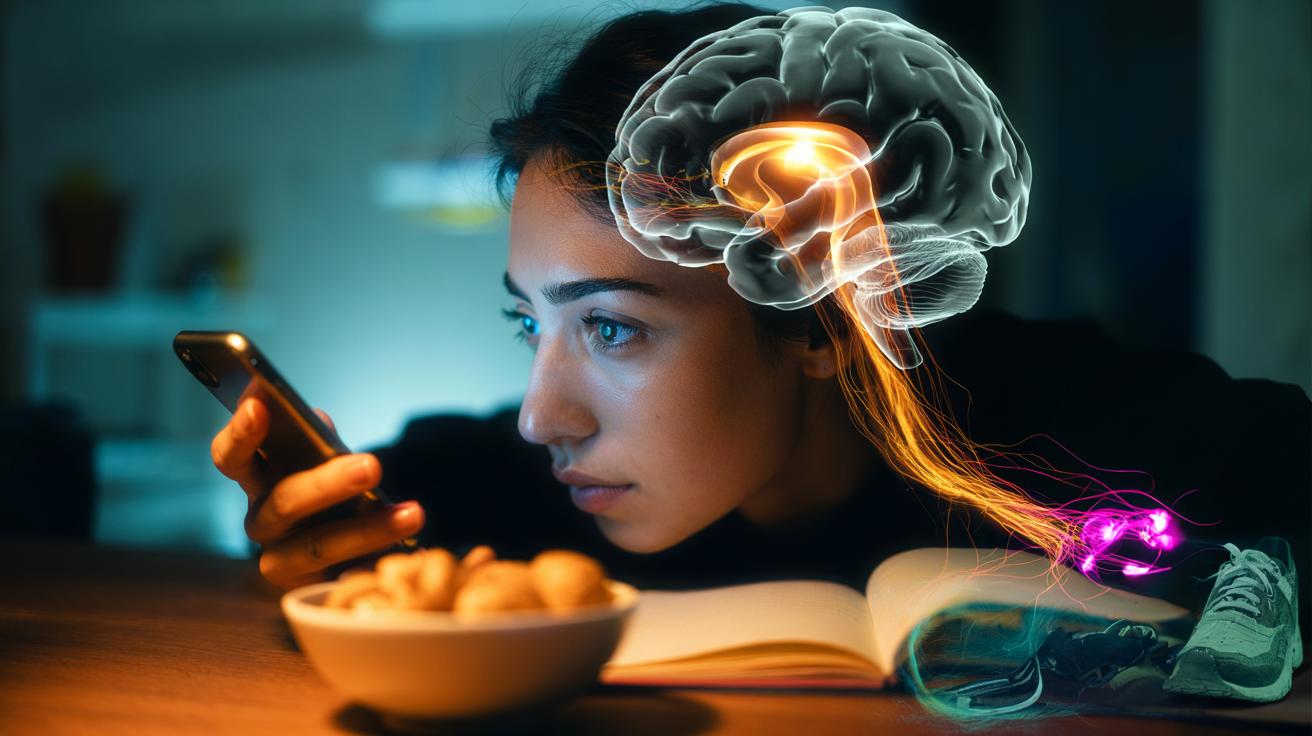
- 🧠 Anticipatory dopamine surges—VTA to nucleus accumbens—hijack attention and action, sidelining the prefrontal cortex and pushing rapid pursuit before reflection.
- 🎯 The engine is reward prediction error: uncertainty amplifies craving; by reducing harmful uncertainty (no badges, hide snacks) and adding constructive uncertainty to good habits, you retune the loop.
- ⚡ Instant re-routing: a two-breath pause, added friction (distance, delay, difficulty), and urge-to-micro-action swaps redirect the “seek” circuit without suppression.
- 📱 Practical cues and fixes: phone buzz → batch checks; snacks in sight → pre-portion and hide; fatigue → “urge surf” plus micro-task—each cuts salience and dampens RPE bursts.
- 🧭 Build lasting defenses: value-led choice architecture, identity statements, visible progress, social scaffolding, and temporal discounting to push temptations into the future.
Temptation rarely arrives as a grand decision. It slips in through a notification ping, a glowing packet, a yawning tab. In those milliseconds, dopamine rises not because of the reward itself but because of what might happen next. Anticipation seizes the wheel. Neuroscience suggests it is this anticipatory surge that reroutes reward pathways, switching your brain from reflective assessment to rapid pursuit. Think of it as a slick shortcut built by evolution to chase opportunities. Powerful, yes. But trainable. Learn to catch that anticipatory spike and you can redirect desire before it hardens into action. Here’s how the mechanism works—and how to flip it.
How Anticipation Hijacks the Brain’s Reward Circuit
The brain’s reward system is less a pleasure fountain and more a prediction machine. When a cue—smell of coffee, icon badge, clink of ice—signals potential reward, the ventral tegmental area (VTA) fires dopaminergic bursts to the nucleus accumbens. This isn’t happiness. It’s a push. A sharpening of attention, a prioritising of the path toward the expected payout. The prefrontal cortex, your planner-in-chief, can be sidelined in the rush. In practice, anticipation collapses deliberation time to almost zero, accelerating you towards the cue-congruent behaviour. That’s why you find yourself halfway through the biscuit before the thought truly forms.
Critical insight: the peak of dopamine often arrives before the reward. Consumption gives a smaller, flatter curve. Anticipation confers urgency, salience, and motor readiness—recruiting the basal ganglia to automate routine responses. Marketers exploit this with countdowns, flashing offers, and variable alerts. Evolution built it to help hunter-gatherers seize scarce chances. Today it latches onto infinite scrolls and instant delivery. If you feel you “lose control”, what you’re experiencing is an elegant system doing exactly what it evolved to do—just in an environment engineered to keep it switched on.
Prediction Error: The Tiny Signal That Drives Craving
The engine under anticipation is the reward prediction error (RPE). When reality beats expectation, dopamine surges. When it disappoints, dopamine dips. The gap—positive or negative—updates your internal model. Uncertainty creates the strongest pull. That’s why a randomised feed or a mystery sale hits harder than a guaranteed coupon. Variable outcomes keep your prediction slightly off, sustaining the chase and training the habit loop. Casinos perfected it with slot machines; social apps translated it into likes, streaks, and intermittent replies.
Notice how the brain tracks three pieces: cue, expectation, outcome. The cue sets your forecast, and the RPE signal amends it in real time. Because the system is fast and mostly automatic, it can outrun reflective goals—diet, savings, writing—whenever cues live nearby. The fix isn’t willpower in the moment; it’s managing the error signal. Reduce uncertainty where temptation is harmful (no snack visibility, no push alerts). Increase constructive uncertainty where you want exploration (creative prompts, randomised healthy options). In essence, you adjust the environment so the prediction error pipeline pays you in the right currency.
Instant Tactics to Redirect Dopamine, Backed by Science
When the cue lands, speed matters. First, shrink the gap between trigger and reflection. A two-breath pause—one deep inhale, one longer exhale—lowers arousal, granting a few seconds for the prefrontal cortex to speak. Second, engineer friction. If the biscuit tin is in the loft, it stops being an automatic loop. Make the temptation farther, slower, and less certain—and its dopamine edge collapses. Third, redirect pursuit. Swap the urge for a micro-action that still satisfies the “seek” circuit: a 60-second walk, ten push-ups, a glass of water, a message to an accountability buddy. You’re not suppressing desire; you’re repointing it.
| Cue | Anticipation Spike | Re-route Technique | Why It Works |
|---|---|---|---|
| Phone buzz | Social reward expected | Silence badges; batch checks hourly | Removes uncertainty; reduces RPE bursts |
| Snack in sight | Sweetness forecast | Hide, pre-portion, add delay timer | Friction shrinks urgency and salience |
| Work fatigue | Escape promised | 90-second “urge surf” plus micro-task | Ride the wave; redirect seeking energy |
Layer in implementation intentions: “If X cue, then Y action.” The specificity locks into the basal ganglia. Make long-term goals immediately rewarding through visible progress—tick boxes, public logs, tiny prizes. Pre-commitment tools (website blockers, card-freezing, leaving the wallet at home) move choice upstream, where anticipation can’t spike as sharply. These tactics don’t deny dopamine. They recruit it. You remain the architect, not the passenger.
Designing Friction and Meaning to Beat Short-Term Lures
Temptation loses when the path to your values is shorter and brighter. Build choice architecture that places desired behaviours at arm’s reach and undesired ones behind effort. Keep your work-in-progress open on the desk. Place fruit, not crisps, at eye level. Fill the first screen of your phone with tools, not toys. Progress visibility is a reward in itself, and progress begets progress. Identity helps too. When you tell yourself, “I’m a runner,” or “I’m a careful spender,” cue conflicts feel like threats to self-image, not merely options to weigh.
Then, weave meaning into the loop. Dopamine isn’t anti-meaning; it’s the engine that carries you towards it. Turn goals into quests with rapid checkpoints. Celebrate inches, not only miles. Add social scaffolding—peer groups, shared dashboards, scheduled “quiet hours.” Temporal tricks help: bundle boring tasks with small pleasures (tea with budgeting), and push temptations into the future where their value degrades (temporal discounting becomes your ally). By designing a world where seeking aligns with purpose, you stabilise the reward pathway and starve distractions of oxygen.
Dopamine anticipation isn’t your enemy. It’s a compass that sometimes points at the nearest shiny object. Understand the mechanism—cues, expectations, prediction errors—and you can rewire the route in real time. Small changes win: a breath, a barrier, a better target for the urge. Over days, those nudges compound into identity. Over months, identity becomes the default. Temptation fades when pursuit points at what matters most. What single cue will you redesign today to turn anticipation into an ally rather than a trap?
Did you like it?4.6/5 (27)