In a nutshell
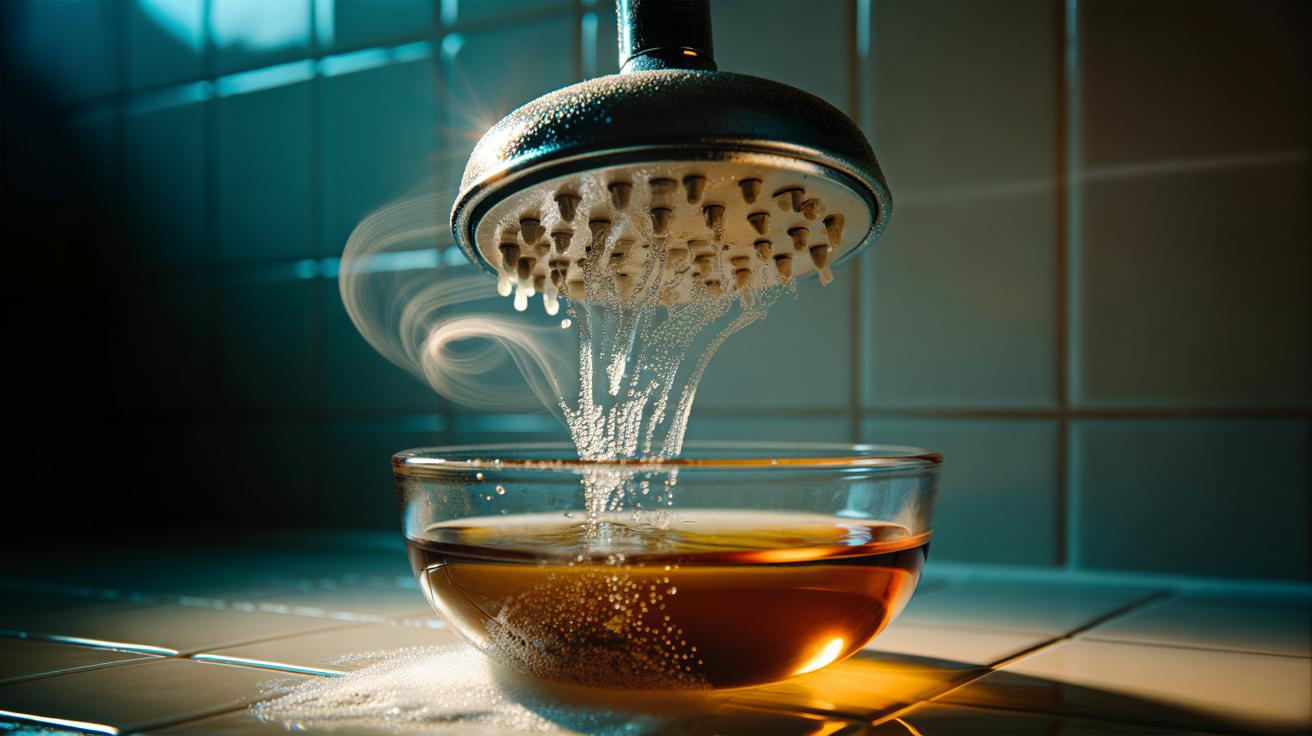
- 🧪 Vinegar vapor spreads into tight spaces, condenses as a thin acidic film, and maintains long contact while using minimal liquid.
- ⚗️ The acetic acid in vinegar dissolves calcium carbonate into calcium acetate, water, and CO2; strong on carbonate scale, weaker on silicates.
- 🛠️ Practical methods: bag-tented showerheads, kettle spout fuming, coffee wand enclosures, and humidifier dishes—follow with thorough rinsing.
- 🔥 Warmth and time amplify results: use gently warmed vinegar (not boiling) to boost vapor and achieve controlled, non-destructive descaling.
- ⚠️ Safety: avoid natural stone, limit exposure on aluminum and some rubbers, never mix with bleach, ventilate, and keep vapor from electronics.
Mineral scale hides in places fingers cannot reach. Think showerhead pinholes, kettle spouts, coffee-machine wands. Traditional scrubs fail there, yet a cupboard staple offers a sly workaround: vinegar vapor. When warmed gently, vinegar’s acetic acid disperses as moist fumes that creep into crevices and loosen crusted deposits without flooding the appliance. It’s slow, quiet, surprisingly effective. Households have trusted vinegar for centuries, but the vapor method is newer in mainstream cleaning. It marries basic chemistry with practical convenience, helping dissolve calcium carbonate and other salts where bristles and brushes stall. Used correctly, vapor turns a stubborn clean into a hands-off fix. Here’s how and why it works.
Why Vapor Works in Tight Spaces
Liquid takes the obvious route, often pooling where it shouldn’t and missing the micro-channels where scale forms. Vapor, by contrast, spreads. Warm, humid vinegar air drifts through vents, valve seats, and showerhead jets, meeting scale exactly where it accumulates. Because it rides convection and diffusion, it coats complex internal geometries that would otherwise demand disassembly.
There’s another advantage: contact time. Soaking risks dilution and runoff. Vapor lingers, condensing into thin, acidulated films that maintain reactivity hour after hour. The film renews itself continuously as fresh vapor condenses. That sustained, gentle exposure is the secret to softening and dissolving crusts without brute force.
Heat matters, but not much heat. Warm vinegar—never boiling inside a sealed device—raises vapor content in air, boosting delivery into cramped spaces. The method also limits volume; that protects electronics and sensitive parts from unintended drenching, a common cause of damage when people overfill housings or tanks.
Finally, the smell is a built-in reminder. It cues ventilation and timing. Vinegar’s odor dissipates quickly after a rinse, but while present it signals the chemistry at work and keeps the process safe and controlled.
The Chemistry: Acidity Versus Carbonate Crusts
Most hard water scale is calcium carbonate (CaCO3) with contributions from magnesium carbonate and mixed silicates. Mild acids dissolve carbonates by converting insoluble crusts into soluble salts. In vinegar’s case, acetic acid (CH3COOH) reacts: CaCO3 + 2 CH3COOH → Ca(CH3COO)2 + H2O + CO2. The products—calcium acetate, water, and carbon dioxide—either rinse away or outgas. As CO2 escapes, the reaction keeps moving forward, thinning the deposit layer by layer.
Vapor doesn’t change the chemistry; it changes access. When acetic-laced moisture condenses on scale, it locally lowers pH at the surface, enough to start dissolving mineral bonds without harshness. Because vinegar is weakly acidic (typically 5–8% acetic acid), it’s less likely to etch metals than stronger acids, yet persistent enough to tackle lime bloom and kettle stone.
Silicate-based scale is tougher and responds slowly. Iron oxide stains also resist, though they can loosen as carbonate layers dissolve. Heat accelerates kinetics slightly, but the big gain comes from constant, thin-film contact that keeps fresh acid at the reaction front. The result is controlled descaling rather than aggressive stripping.
Practical Methods for Hard-to-Reach Fixtures
Showerheads: Fill a freezer bag with warm vinegar, leave head attached, and tent the bag so the jets sit above liquid level but inside the “vinegar atmosphere.” Seal loosely and leave 1–3 hours. The vapor permeates jet channels. Afterward, run hot water and flex nozzles. If the head is removable, a gentle warm soak plus vapor tenting speeds results.
Kettle spouts and lids: Place a small cup of vinegar inside the empty kettle, close the lid, and warm the kettle externally for a minute or two—do not boil dry. Turn off. The internal space fills with vinegar vapor that kisses the spout throat and lid seams. After 30–60 minutes, add water, bring to a brief boil, discard, and rinse twice.
Coffee steam wands and valves: With the machine off and cool, hang a mug of hot vinegar under the wand, enclosing wand and mug top with a silicone cover or foil to trap fumes. Avoid powering steam; let passive vapor work. Rinse thoroughly, then purge with fresh steam to clear residues.
Humidifier ducts and corners: Set a shallow dish of warm vinegar inside the empty tank compartment, reassemble the cover, and let it sit for two hours. The trapped acidic humidity softens scale lines so a subsequent water flush removes them. Never run vinegar through ultrasonic elements unless the manufacturer explicitly allows it.
Safety, Materials, and When Not to Use Vinegar
Test first, always. Vinegar vapor is mild, but sensitive surfaces exist. Natural stone such as marble or travertine is mostly calcium carbonate; acid will etch it. Bare aluminum can pit over long exposures. Some rubber gaskets swell if left in acidic humidity for hours. Keep rooms ventilated. Do not mix vinegar with bleach or peroxide cleaners; harmful gases can form.
Use low heat and patience. A gentle warm-up increases effectiveness without stressing plastics. After treatment, rinse with plenty of water. If a faint sour note lingers, a second water flush is enough—avoid adding baking soda during the process, as it neutralizes acid prematurely and kills the reaction.
| Surface/Deposit | Typical Location | Vinegar Vapor Effective? | Notes |
|---|---|---|---|
| Calcium carbonate | Showerheads, kettles | Yes | Best with warmth and time. |
| Magnesium carbonate | Boilers, irons | Yes | May need repeat cycles. |
| Silicate scale | Old pipes, glass | Limited | Long exposure; consider specialty descalers. |
| Marble/stone | Tiles, sinks | No | Risk of etching; avoid contact. |
| Aluminum | Pans, housings | Caution | Short exposures only; rinse well. |
One last boundary: electronics. Vapor is moisture. Keep it out of boards and motors. For appliances with mixed compartments, isolate the scaled section with a tent or bag so reactive humidity doesn’t spread where it shouldn’t. If in doubt, default to a manufacturer-approved descaler. The goal is targeted, reversible cleaning—not collateral corrosion.
Vinegar vapor proves that gentle chemistry, applied cleverly, beats brute scrubbing in narrow spaces. It’s cheap, accessible, and—when handled with care—remarkably effective against everyday mineral build-up. Warmth amplifies reach; time does the hard work; a clean-water rinse resets the surface. In a small domestic miracle, you watch hard scale soften and vanish without taking anything apart. Where could this low-tech, high-ingenuity method save you the most frustration at home, and what tight, neglected corner will you tackle first?
Did you like it?4.5/5 (29)